

Introduction
Automation has transformed modern sheet metal manufacturing. Among the most important advancements is the welding robot workstation, a fully integrated system that ensures consistent weld quality, improved productivity, and enhanced workplace safety.
For industries requiring precision components such as data centers, new energy systems, and industrial automation equipment, robotic welding has become a core manufacturing solution.
What Is a Welding Robot Workstation?
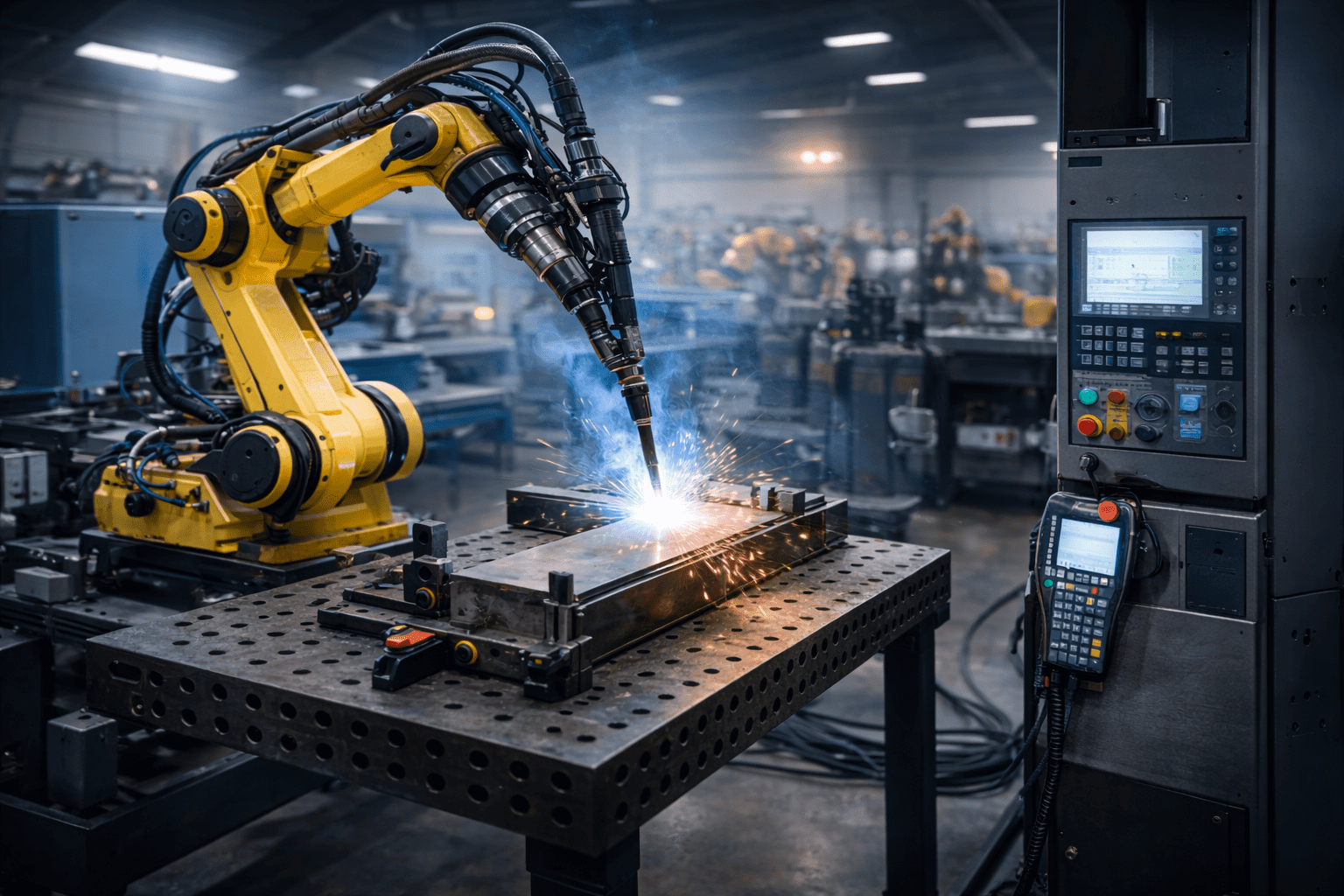
A welding robot workstation is an automated welding system composed of:
- Industrial robot arm
- Control cabinet
- Welding power source
- Positioning equipment
- Monitoring and sensor systems
This system works together to perform high-precision welding tasks with minimal human intervention.
How It Works
The working process follows a programmed control cycle:
- Welding trajectory and parameters are programmed.
- The controller converts commands into motion signals.
- Servo motors drive the robotic arm.
- The welding torch executes precise welding.
- Sensors monitor alignment and adjust deviations in real time.
This closed-loop system ensures stable weld seams and repeatable quality.
Key Benefits for Sheet Metal Manufacturing
High Precision
Dimensional consistency improves significantly compared to manual welding.
Stable Quality
Defect rates are reduced, and qualified rates can exceed 99%.
Increased Productivity
Production speed increases while maintaining uniform weld performance.
Improved Safety
Operators avoid exposure to high heat and welding arcs.
Application Fields
Welding robot workstations are widely used in:
- Industrial automation frames
- Data center enclosures
- Electrical cabinet manufacturing
- Agricultural machinery
- Automotive sheet metal components
Conclusion
Welding robot workstations are essential for companies aiming to scale production while maintaining high-quality standards. With intelligent control and advanced automation, they provide a reliable foundation for modern sheet metal manufacturing.